The best news you’ll hear about absenteeism today: we can do something beautiful about it.
Since the COVID-19 pandemic—in schools across the US and in New York City where Morningside does the majority of our work—attendance gaps and chronic absenteeism have skyrocketed.
The problem is so deep-seated that research on the many sides of this kaleidoscopic problem continues to voraciously debate every angle: what causes it, what we believe about it, who can have an impact and how to change it.
The Collaborative for Academic, Social, and Emotional Learning (CASEL) shared new survey findings in September:
Only about 1 in 5 [20% of respondents] felt that improving attendance was very much within their control…. At the same time, respondents strongly endorsed belonging as central to attendance, though they were less consistently confident that they personally shape school climate.
These findings suggest that educators recognize the problem of absenteeism and believe in climate-based solutions in principle but do not uniformly see themselves as empowered to act. (https://casel.org/the-attendance-paradox/#)
CASEL’s July research adds critical context:
[S]chools serving similar students in similar neighborhoods often post markedly different attendance rates—strong evidence that what schools do matters.” [CASEL] argues that the relationships students experience and the SEL skills those relationships build are among the most powerful, controllable levers schools have, because they address several root causes of absenteeism—disengagement, weak belonging, and a sense of academic failure—at once. (https://casel.org/connection-that-keeps-students-coming-back-07-2026/)
“Through restorative circles, my fourth-grade students have begun to demonstrate a deeper sense of safety, voice, and belonging within our classroom community. Conversations centered around acceptance, kindness, and racism have allowed students to openly share their experiences, listen to one another, and build empathy. I have noticed students becoming more thoughtful in how they speak to each other, more willing to express their feelings, and more intentional about creating an inclusive and respectful environment.” - A District 6 Educator
That’s what Morningside does! Through SEL, restorative practices and equity work—we impact school climate and culture exactly for the purpose of building relationships; growing student voice, belonging and inclusion; and making school a place that children—and adults—want to be.
Over the past few months, we have done a deep data dive of our own—both quantitative and qualitative. Last spring, we surveyed 85 teachers at schools doing whole-school work with Morningside—some for one year, some for two and one school for 4+ years. Here’s what we learned:
- 87% of educators saw increases in safety, voice and belonging across 7 specific observable categories; and 32% saw increases in 4 categories! The most observable benefits:
- use of voice
- relating to peers
- belonging
- 82%+ of educators reported having better relationships with their students
“Students who are normally quiet during whole group activities are more willing to participate when there is a talking piece being passed around.” – A District 6 Educator
- 82% of educators reported growth in positive student discipline practices and trust
“Students are beginning to ask for restorative circles whenever they have a problem impacting our classroom community.” – A District 6 Educator
- 71% of educators reported students demonstrate feeling a new/deepened sense of safety, voice and belonging
“Students support each other and take ownership over their actions more because they have the voice to talk about it.” – A District 5 Educator
Morningside trains, coaches, supports, and provides leadership and crisis team coaching and positive discipline planning. We have ever-evolving and up-dated curricula and programming in SEL, RP and equity for pre-K – 12th, as well as youth development programs. We support parents and caregivers with a suite of workshops. We train and coach After-School and CBO leaders and staff. And we’ve been doing it for almost 45 years—with hundreds of years of experience and expertise across a staff of 45 who are 80% people of color and represent numerous diverse identities.
So, when we hear CASEL survey educators say they know school climate & culture change is the answer but they don’t feel empowered to act, we know it’s time to fly our flag a little higher! We know what changes to make, how to make them, and how to empower every member of the community.
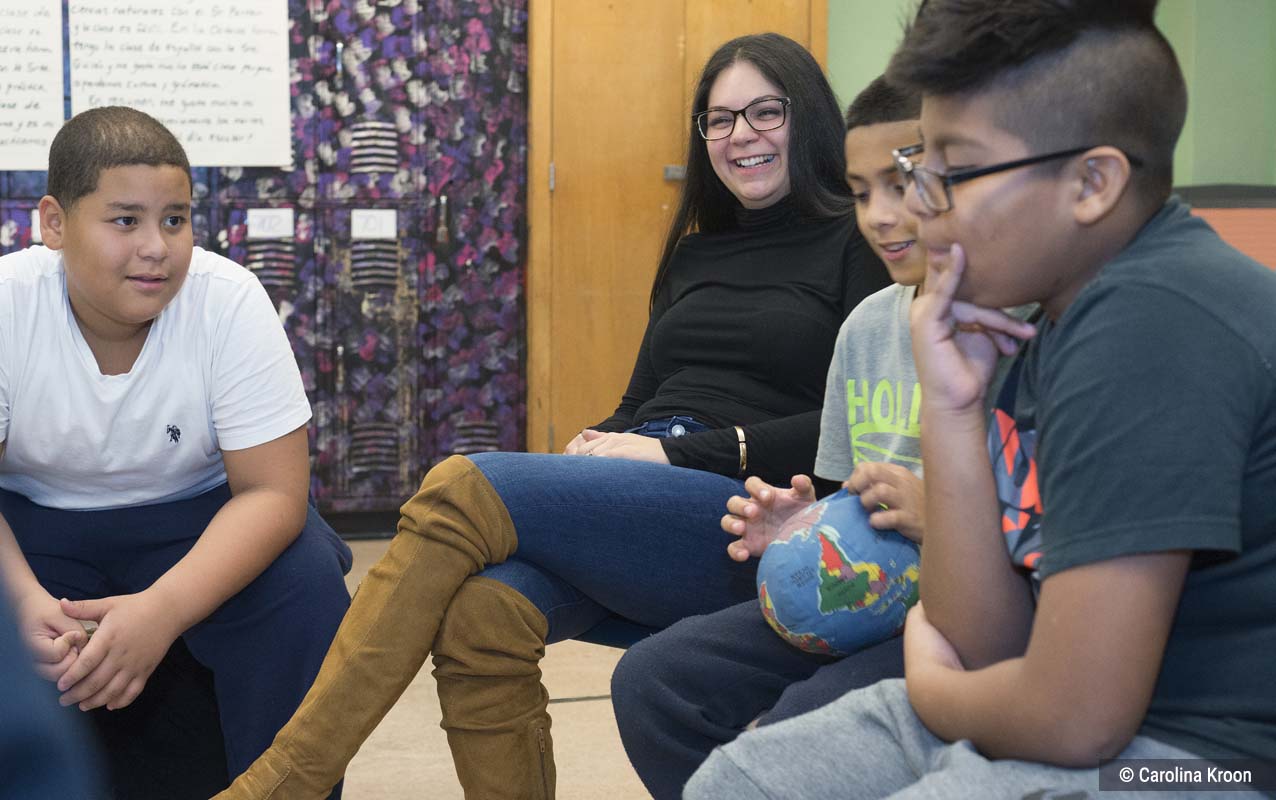
Young people—like all of us—want to be where they feel that they belong and are valued; where they hold important relationships with trusted adults. That’s what our work is about.
We will leave you with a quote from a Morningside collaboration school:
“We held regular community circles in which kids could connect with each other, gain an understanding of what made others tick and build compassion and care. We introduced routines and structure that provided consistency during the school day; a predictability these students needed to calm their bodies and let down their guard. We also worked closely with them, so that they could learn to express their emotions in a safe way.”
This is the work of a whole community coming together in a continuity of care that extends to every child and every adult in the school community. Schools can’t do it alone—Morningside is here to help you build this beautiful new world in your school. And yes, it takes every member of the community.
That is the beautiful something we can do about absenteeism: create and nourish community. The mutual reception of community and individual is an experience of beauty that feeds us all.
Contact us anytime at info@morningsidecenter.org to learn how we can support change for every student and every adult in your school community.